Autism & social control
by K.J. Elphinstone, June 2026
-
Social hierarchies & power dynamics
Power hierarchies work best in unspoken ways. This means that, when we want to guard them, we can’t openly state our reasons – nor explain why we’re so perturbed when people flout them.
In fact, it’s quite likely we don’t know, consciously, why we are.Instead, we may say things like, “it’s just not right” or “it’s unnatural”, or use other such non-sequitur arguments that our culture is so fond of.
People identifying with their autism can clearly be experienced, by society at large, as quite unsettling. The reason, perhaps, is this: people are only meant to willingly wrap their identity up in those labels that give them more status in society; never less.
It's an unwritten, unspoken law.
You’d never choose to be a woman; choose to be a weirdo or a loser; choose to identify as an animal.
Indeed, to insult somebody, it's always been quite normal to say things like:
“He was crying like a girl,”
“There’s something strange about her,”
or,
“You’re such a pig!”In this reality, it would be highly unnatural and freakish if you took these identities on voluntarily. At best, others would just think you'd lost your mind. At worst they'd annihilate you.
Understandably really, given the entire structure depends on people striving to be on the top of it.
Looking back over the history of autism, if you had some privilege (and parents who were determined enough, and had sufficient clout), you might be given a detachable label. An unavoidable but unwelcome house guest who, once safely installed, might allow you – and by extension, your family – to escape some of the worst stigma and blame you’d otherwise have faced.
This relative privilege has been traditionally reserved for young white boys.1 Though some white girls got through – and one or two wealthy non-white children.2
But now... what's happening?
-
The neurodiversity movement
There’s a whole identification movement going on! Weaving connections, spreading understanding. Sharing information about lived experience. Creating community.3 And – terrifyingly – it seems that pretty much anyone identifying as neurodivergent, regardless of their social identity or background, will be welcomed.
Yes, the neurodiversity and self advocacy movement is creating consternation – even panic – within the ivory towers of the establishment.
It's quite bizarre given how raggedy of a bunch we are. It's like the motley crew of the peasants in the fields by the castle walls – next to our little camp fires and infodumping to each other, perhaps playing some music, having a nap, stimming, and comparing our scars. And saying to anyone else who emerges from the bushes, here, have a bite, and here's a blanket. And the royal family in the castle looking out their tower windows, certain that our bassoons must be AK-47s.
But yes, I understand the fear. Because the lunatics escaped the asylum. And that spells change.
Indeed, this kind of mass movement of the previously incarcerated/punished could have the power to effect changes to society's core. To its very foundation.
Globally, our systems of survival and daily life are deeply tied to an economic model built on competition. This competition both depends on and produces social hierarchies. The division that takes place between people and socially defined groups isn't accidental; it's how the system works. Categories are a handy way to organise, rank, and control people.
But when those same categories are used by the marginalised groups themselves, e.g. towards solidarity or even liberation – well, then they become a problem. This is when there may be talk of redefining, even dismantling them.4
Not to mention how, almost as if to add insult to injury, there's that annoying autistic tendency to doggedly look for clarity, patterns, and logic in things. Understandably, this may be experienced as quite unsettling within power structures that heavily rely on subterfuge and the ‘unspoken’.
-
Change & political agendas
Some traditionalists are reacting to the neurodiversity movement by proposing tighter restrictions on who can call themselves ‘autistic’.
The inclination (of course) is to first push autistic women and girls out of the ‘autism’ queue. As for non-white autistic people, and autistics in other marginalised groups all over the world – well, that seems to be seen as less of a priority, perhaps because so few have been allowed into the queue in the first place.The plan would be to close the main thoroughfare leading to those fields – and install guarded gates instead.
Entrance would be tightly restricted to those with the right passports and papers – through stringent, socially-approved documentation procedures, certified only by highly trained professional gate-keepers, and (of course) correctly rubber-stamped.
On the surface it's about logistics, and money – but I feel that the determined lack of engagement on larger topics such as social equity, human rights, and the political and economic climate, is somewhat telling.
As long as the narrative remains that autistic people are costing the public purse a fortune – without mentioning the billions already spent on prevention, cure, and the hunt for biomarkers, which autistic people never asked for and which doesn't benefit them much – political attention can be diverted away from the real question.
That question is why so much money is being spent on preventing meaningful changes in society, on silencing the voices of young people, and on gatekeeping support from people who need it – for any reason – while more and more of our shared resources disappear into the howling vortex of the global super-wealthy.5
I can’t help but wonder how much money it all – the gates, the high walls with barbed wire on top, all that paperwork, the trained and certified guards and clerks – must cost, for such a grand exclusion exercise as this. And will they also go through the crowds already in the fields, segregating people, marching many out of there? The mind boggles.
The PR needed for such an operation will be costly, too, especially when the young ones keep refusing to fall into line. But goals are often achieved by winning over hearts and minds. As long as a designated marginalised group can be gently but persistently discredited in the larger world, then the rest can follow.
Perhaps surprisingly, progressive people can be helpful to this end. Some of these might even be therapists, teachers, clinical psychologists, or even just general broad-minded people with no ties to the topic. Anyone can contribute! Autistic people and their parents, however, can be awkward. There's usually no sense trying to deal with them directly.
With a generous sprinkling of phrases like, “Who needs labels anyway?” or “We’re all a bit autistic,” you can quickly bring autistic people right back (in implication if not in words) to that place where they were simply dubbed lazy and crazy – and left out in the cold, without even each other to talk to.
The general confusion can also be innocently added to by mixing up being ‘neurodiverse’ (which, by definition, includes everyone who possesses a brain and nervous system) with being ‘neurodivergent’ (which, by definition, includes some people but not everyone). This can all feel quite natural, as so many of us can be persuaded that ‘divergent’ sounds... ahem... too much like a slur.
All this seems to be making a sweeping gesture towards some beautiful, egalitarian world. One where nobody is boxed in or made lesser by categories.
What a beautiful vision! But, sadly, a fantasy. We don't live in that world. Not yet, anyway.
And if we ever do want to live there (rather ironically), it might be more productive not to place our own well-meaning little pebbles into the kyriarchy’s walls.6
-
The bigger picture
I think, after all, it's not such a mystery why society is so attached to the ‘negative or nothing’ model of autism.
As a result of the neurodiversity movement and others like it, the logic behind who gets to have social legitimacy has started to unravel. The emperor’s robes haven’t quite fallen away, perhaps – but they've been left looking increasingly threadbare.
Yes, perhaps the establishment is right to be scared. If enough of those threads were to fray, the whole costume could come apart.
It seems the insistence on autism being ‘negative or nothing’ has never really been about objectivity, or anything intrinsic to the condition itself.
And instead has been more about maintaining larger systems of social control.
My last article explored why there's so much resistance in the mainstream to autism being understood as an identity.
This one looks at how that resistance fits into wider systems of power in society.
Images reprinted in this article with permission from the photographers as follows:
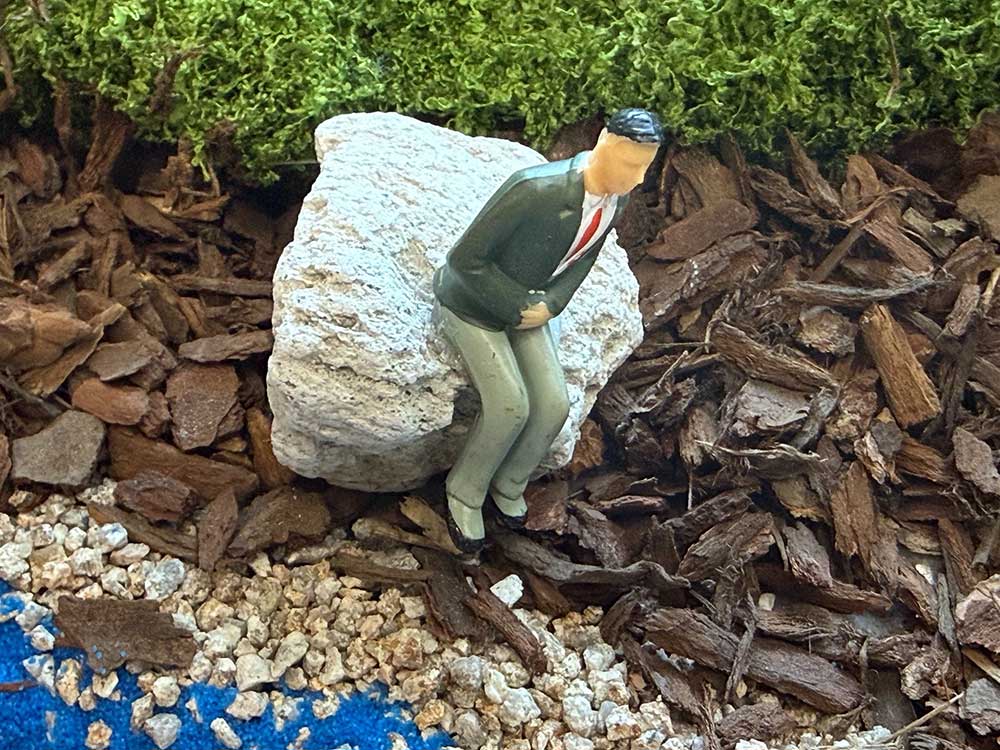
1. Stomach ache, Panda Mery, web site https://gizmonaut.net
2. Rainbow from the car window, Ros Elphinstone
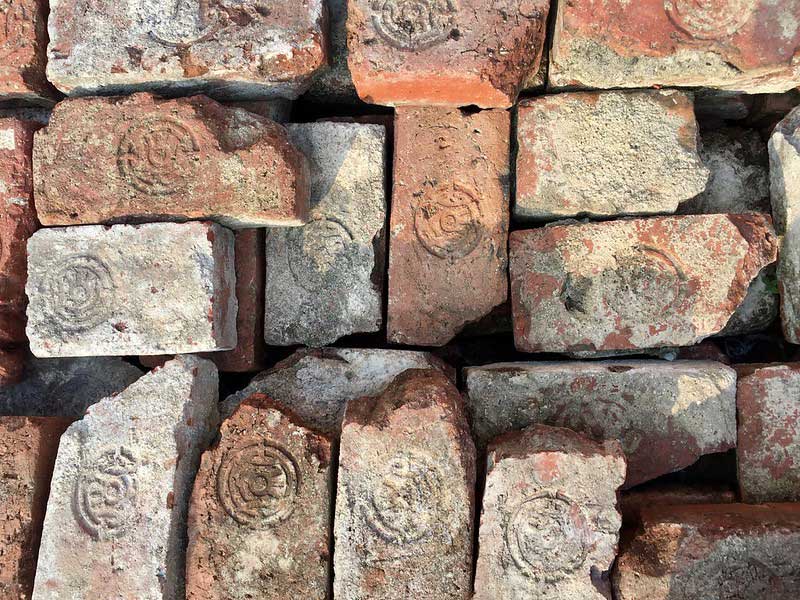
3. Prison made bricks, Panda Mery, web site https://gizmonaut.net
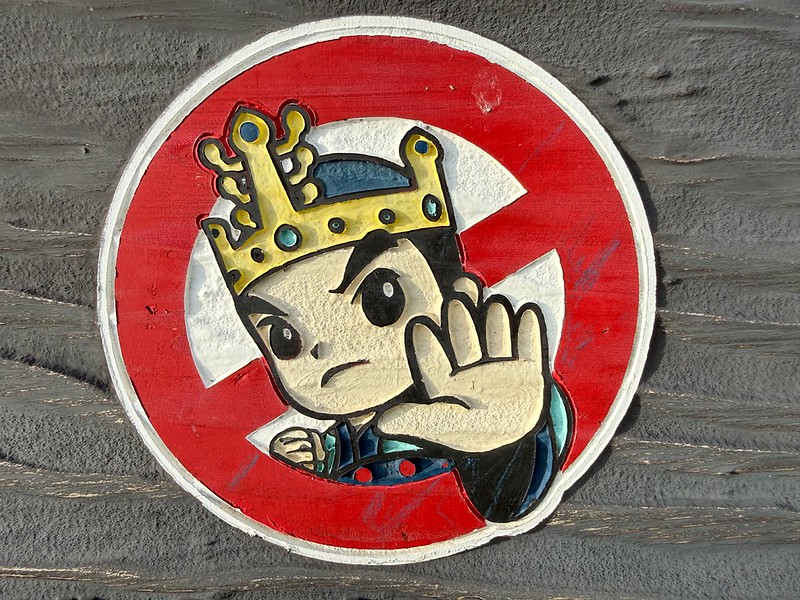
4. The king says no, Panda Mery, web site https://gizmonaut.net
Footnotes
Under Asperger’s Nazi-era framework, some autistic children were treated as salvageable, while others were exposed to institutionalisation and death; those cast as salvageable were boys (Czech, 2018; Sheffer, 2018).
Autism diagnosis has historically been shaped by race, gender and class, with girls and racially minoritised children more likely to be missed or diagnosed later (Loomes, Hull and Mandy, 2017; Mandell et al., 2009; Roman-Urrestarazu et al., 2021).
The neurodiversity movement grew out of autistic-led culture and self-advocacy, especially from the 1990s onwards, challenging deficit-only models of autism and arguing for autistic ways of being as valid rather than merely pathological.
Foucault’s writings on discipline and normalisation, such as ‘Discipline and Punish’ and ‘Madness and Civilization’, show how social power inexorably classifies, ranks and corrects people.
On gatekeeping support, see Herd and Moynihan’s work on ‘administrative burden’, which examines how bureaucracy can block or discourage access to public goods and benefits. On upward extraction of shared wealth, see Mazzucato on value extraction and rent-seeking, Varoufakis on techno-feudal rent extraction, and Oxfam’s work on the growing concentration of billionaire wealth (Herd and Moynihan, 2018/2025; Mazzucato, 2018; Varoufakis, 2023; Oxfam, 2025/2026).
‘Kyriarchy’ is used here in Elisabeth Schüssler Fiorenza’s sense: not simply patriarchy, but interlocking systems of domination, hierarchy and submission (Schüssler Fiorenza, 1992).